
Reviewed · RIO DE JANEIRO TOURS
Rio by Day – Main Sights Tour
Rio by Day packs the city’s big sights into one ambitious outing. You move from Leblon and Ipanema’s beaches to the Metropolitan Cathedral, Sugarloaf Mountain, Maracanã, and Christ the Redeemer, all with hotel pickup and drop-off in Rio’s South Zone.
I like two things in particular: the prearranged transport and admission option, which cuts down on ticket lines and planning, and the chance to see Rio from several angles, including the beaches, Guanabara Bay, Tijuca Forest, and two famous mountaintops. Guides Karla, Gabi, and Michael have each received praise for being helpful, kind, and punctual.
The tradeoff is simple: this is a lot of Rio in roughly 10 hours. You will see nearly everything, but stops are short, traffic can slow the day, and lunch may come as late as 4 p.m. if the schedule slips.
Key points to know before booking

- Six major sightseeing zones in one day: Visit the South Zone beaches, downtown, Sugarloaf, Maracanã, Tijuca Forest, and Christ the Redeemer.
- Pickup starts around 8 a.m.: Hotel transfers cover most properties in São Conrado, Leblon, Ipanema, and Copacabana.
- Choose your ticket option carefully: Cable-car rides, the Corcovado train, and barbecue lunch are included only in the tickets-and-lunch option.
- A group can reach 35 people: The private upgrade is worth considering if you want more control over timing and guide attention.
- The best views depend on conditions: Fog or cloud can affect the mountaintops, as one experience did, so keep expectations flexible.
- The pace is brisk: The tour works best as a first look at Rio, not as a slow visit to each attraction.
Is this the right way to see Rio in one day?
If your time in Rio is short, this tour solves a real problem. Rio’s sights are spread across a wide area, and visiting them independently means arranging transport, checking opening times, buying tickets, and allowing for traffic. Here, a guide links the stops together, from the shoreline to the city center and then up into the hills.
The price is listed at $164.66 per person, but the value depends on the option you choose. The lower-priced version does not include the Sugarloaf cable cars, Corcovado train, or barbecue lunch. The option with tickets and lunch costs more, yet it may be the sensible choice for a one-day visit because these are the main activities that make the day work.
You also get a professional guide, a panoramic city tour, hotel transfers in the South Zone, and live audio support in nine languages. For a first overview, that removes much of the guesswork. For a second or third day in Rio, I would prefer a slower outing focused on one area.
The group limit is 35 people. That is large enough for the tour to feel organized rather than intimate, but it can make loading, unloading, and keeping to the timetable harder. The private upgrade is aimed at people who want undivided guide attention and greater flexibility.
A few more Rio de Janeiro days to weigh up
- Rio de Janeiro: 6-Stop Highlights of Rio with Lunch
★ 4.4 · 5,157 reviews - Christ the Redeemer Entry Ticket by Corcovado Train
★ 4.4 · 4,476 reviews - Rio de Janeiro: Rocinha Favela Walking Tour with Local Guide
★ 4.8 · 3,052 reviews
Leblon, Ipanema, and Copacabana from the road
The day begins with Rio’s famous beach neighborhoods. At Leblon, you stop for views toward Morro Dois Irmãos, the twin-peaked hill that gives the western end of the beach its distinctive shape. This is a useful first look at Rio’s unusual setting, where dense city blocks meet sand, steep hills, and open water.
Ipanema follows. The beach stretches about 2 kilometers between Arpoador and Jardim de Alah, and its name is tied to the familiar song about the girl from Ipanema. The tour gives you context about the neighborhood and points out places linked to daily Carioca life.
The sea here is not only for sitting in the sun. Some sections have stronger waves and currents, and the beach is used for sports. That matters if you are hoping to swim, since the day gives you a view of the shore rather than a dedicated beach stop.
Copacabana covers about 4 kilometers and is perhaps Rio’s most recognizable urban beach. Look down at the Portuguese-stone pavement, whose black-and-white wave design is associated with Brazilian landscape designer Burle Marx. You also hear practical suggestions about what to do in these neighborhoods later.
The beach stops are brief, so do not expect a relaxed morning by the water. Their real value is orientation. You see how Leblon, Ipanema, and Copacabana connect, and you get a sense of the city’s social life before turning inland.
Botafogo and the first Sugarloaf views
The route heads toward downtown along Botafogo’s shore. From here, Sugarloaf appears across Guanabara Bay, and you get views toward the water, nearby beaches, the Santos Dumont Airport, and the hills around the city.
Botafogo is also one of the places where Rio’s outdoor habits are easy to spot. Volleyball, soccer, and footvolley use the sand, while cyclists, joggers, and walkers follow the bike path and boardwalk toward Flamengo Beach.
This part is a drive with commentary rather than a long stop. That is useful because you see how the neighborhoods fit together without spending the whole morning walking between them. It also creates an early preview of Sugarloaf, which you visit properly later.
Laranjeiras, Guanabara Palace, and the Sambadrome
The drive continues through Laranjeiras, a neighborhood associated with Guanabara Palace. The building was once the home of Princess Isabel, who signed the Golden Law abolishing slavery in Brazil. It now serves as the official headquarters of the government of Rio de Janeiro.
The coach also passes near the Sambadrome, where the annual samba school parade takes place. You see the site from outside, so this is a quick historical and cultural reference rather than a full visit.
These drive-by sections are easy to underestimate. They do not offer much time for photographs, but they fill in the city’s story and give you a better sense of how Rio’s political, cultural, and festival spaces sit among its residential districts.
Same city, a completely different kind of day:
- Rio de Janeiro: Sugarloaf Cable Car Official Ticket
★ 4.6 · 2,873 reviews - Rio: Christ the Redeemer, Sugarloaf, Selaron & BBQ Lunch
★ 4.5 · 2,428 reviews - Rio De Janeiro: Half-Day Rocinha Favela Walking Tour
★ 4.7 · 2,272 reviews - Rio de Janeiro: Angra dos Reis and Ilha Grande Full-Day Tour
★ 4.6 · 1,673 reviews
Inside the Metropolitan Cathedral in 15 minutes
The Metropolitan Cathedral of Saint Sebastian is one of the day’s most unusual buildings. Its form is pyramidal, with an internal diameter of about 96 meters and a height of 80 meters.
You spend about 15 minutes here, and entry is included. The visit is short, but the cathedral rewards a look inside because its scale and shape differ sharply from the more traditional churches you may expect in a historic city center.
Do not plan on a long, quiet visit. The cathedral is one piece of a fast-moving city tour. Still, this is a good stop because it is not simply a photo from the bus window. You get to enter, look upward, and take in the structure before continuing downtown.
Downtown Rio, Cinelândia, and the Municipal Theater
The downtown portion is panoramic. You pass historic streets and buildings, hear stories about the area, and get views of Cinelândia Square. The Municipal Theater is a key sight here, with Art Nouveau architecture that gives the square much of its character.
This section is designed to help you get your bearings rather than study individual buildings in detail. If you are interested in Rio’s architecture or political past, you may wish you had more time on foot. If your priority is to see the city’s major landmarks in one day, the drive-through format keeps the schedule moving.
The guide’s role matters especially here. A street can look like ordinary city scenery unless someone explains what happened there and why the building matters. The experience includes live audio support in nine languages, which can help if you are not following every spoken detail from the guide.
Sugarloaf by two cable cars
After downtown, the route crosses Aterro do Flamengo, a broad park area associated with Burle Marx. Commentary covers Brazil’s role in World War II and the founding of Rio in the late 1500s before you reach Urca and Sugarloaf.
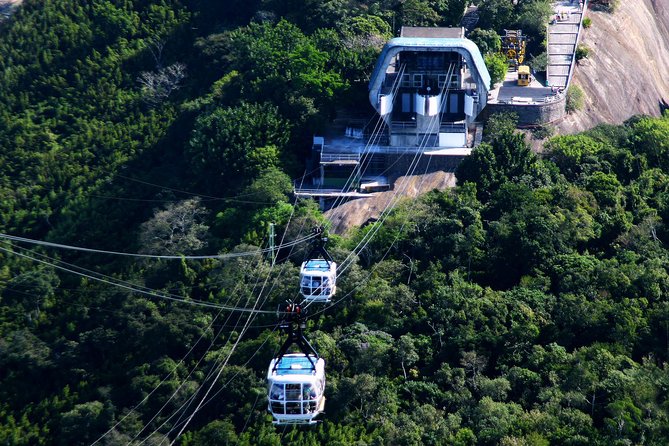
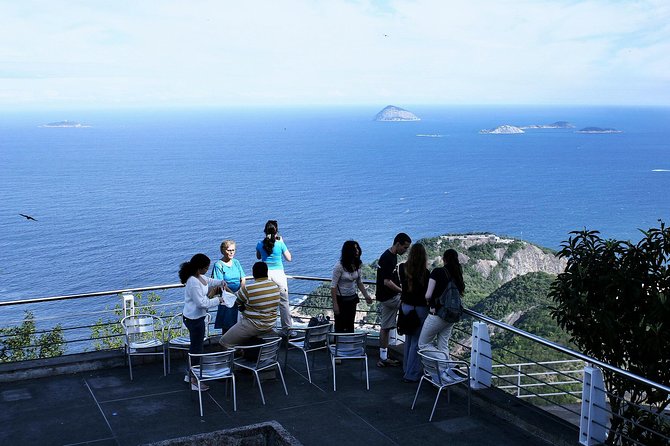
The first cable car takes you to Morro da Urca, about 215 meters above sea level. From there, you can see Guanabara Bay and its islands, Flamengo and Botafogo beaches, Santos Dumont Airport, the Rio-Niterói Bridge, Urca, and Corcovado.
A second cable car continues to Sugarloaf Mountain, which rises to about 395 meters. From the top, the views extend toward Copacabana, Niterói, and Santa Cruz Fortress. This is one of the strongest parts of the day because the city’s shape becomes clear: beaches, bay, airport, bridge, hills, and neighborhoods all appear together.
The stated time at Morro da Urca is about 15 minutes, followed by about 40 minutes at Sugarloaf. That is enough for photographs and a look around, but not a leisurely mountain visit. Cable-car admission is included only if you choose the tickets-and-lunch option, so check the exact package before paying.
Fog can affect the experience. One recorded outing had fog, and that is a reminder that a famous viewpoint is never a guarantee of a clear panorama. The mountain is still a memorable stop, but you should not judge the whole day by one weather-dependent view.
Barbecue lunch, with a late-lunch warning

The planned meal is at Carretão Ipanema Classic Grill, a Brazilian churrascaria with an all-you-can-eat format. You can expect a wide selection of side dishes and vegetarian choices, so the meal is not limited to people who want meat.
Lunch is included only with the selected tickets-and-lunch package. If you choose the version without lunch, the guide offers nearby suggestions at different price levels and with different food choices.
The timing deserves attention. One outing reached lunch close to 4 p.m. after delays. That is late for most people, so bring water and perhaps a small snack if you need food at regular times. The meal itself is scheduled for about 1 hour and 20 minutes, which gives you more breathing room than most other stops.
I see the lunch as a practical part of a long day rather than the reason to book. It gives you a proper break and lets you try a Brazilian barbecue format, but the late hour is a real possibility when traffic or earlier stops run over.
A quick look at Maracanã
The stop at Maracanã lasts about 10 minutes, and you see the stadium from outside. You make a lap around the stadium area and hear about its opening in 1950, when Brazil hosted its first World Cup.
The stadium has hosted two World Cup finals, so even a short exterior stop carries plenty of sporting significance. Football fans will likely want more time, but this tour does not include an interior visit or a match-related experience.
For most people, Maracanã works as a quick photo stop and a chance to connect Rio with Brazil’s football identity. Keep your expectations narrow and you will not feel shortchanged.
Through Tijuca Forest to Christ the Redeemer
At Cosme Velho Station, near the base of Corcovado, you board the train toward Christ the Redeemer. The ride takes about 20 minutes and passes through Tijuca National Park.
The forest covers about 7 percent of Rio’s territory and is described as the world’s largest urban forest. The train ride is valuable because it shows that Rio’s green hills are not simply distant scenery. They press close to the neighborhoods and form part of the city itself.
The Corcovado train ticket is included only with the tickets-and-lunch option. If it is not included in your package, confirm how the ticket purchase will be handled before the day begins, since the whole schedule depends on reaching the statue efficiently.
At the top, you can use a lift and escalator or climb the traditional 222 steps. The 38-meter Christ the Redeemer statue rises above the summit with open arms, and the view reaches across Rio’s South Zone toward Niterói.
You have about 40 minutes at the top. That is enough to see the statue from several sides and take photographs, but the area can feel rushed if you want time for quiet reflection or a careful look at every viewpoint. Still, this is the essential Rio sight, and the combination of forest train, mountain setting, statue, and city view makes it the day’s main payoff.
Timing, transfers, and group size
Pickup begins at 8 a.m. and covers most hotels in São Conrado, Leblon, Ipanema, and Copacabana. The transfer is included for those South Zone areas, but you should confirm your hotel qualifies before booking.
The tour may collect other passengers. A useful scheduling tip is to request pickup from the last departure point if you want to reduce the time spent waiting for additional pickups. The group can include up to 35 people, so the start may not feel as quick as a private car.
The full day lasts about 10 hours. That sounds generous, but Rio traffic and the number of stops leave little spare time. Guides Karla, Gabi, and Michael have been singled out for kindness, timely organization, helpful information, and attentive service. That personal organization can make a major difference on a day with this many moving parts.
The tour does not operate on Carnival, December 24, December 25, December 31, or January 1. Wear comfortable clothes and walking shoes, and bring sunscreen, sunglasses, and a hat for hot conditions.
Free cancellation is available up to 24 hours before the start time. Changes or cancellations inside that window are not accepted for a refund.
Who should book this full-day Rio overview?
I would choose this tour if you have only one or two days in Rio and want to cover the major sights without building a complicated plan. It is also useful at the start of a longer stay because you can learn where the beaches, downtown, bay, stadium, and mountains sit before returning to your favorite areas independently.
It suits people who value coverage and convenience over a relaxed pace. Families and first-time visitors may appreciate the included transfers and guide support, while visitors who dislike planning tickets may prefer the package with admission and lunch.
I would hesitate if you want long beach time, extended museum visits, a full Maracanã interior tour, or a quiet meal at a set hour. The day is tightly packed, and delays can push lunch late. The private upgrade makes more sense if you want personal guidance or hope to control the pace.
The tour is recommended by 97 percent of customers and carries a 4.8 rating from 31 reviews, with particular praise for guides who stay helpful and organized even when conditions or timing are not perfect.
Should you book Rio by Day?
Book it if your goal is to see Rio’s headline sights in one efficient sweep. The beaches, Cathedral, Sugarloaf, Maracanã, Tijuca Forest, and Christ the Redeemer create a strong first picture of the city, and hotel pickup removes much of the day’s transport stress.
Choose the tickets-and-lunch option if you want the simplest experience and do not want to arrange cable cars, the Corcovado train, or a meal yourself. Choose the private version if personal attention matters more than price.
Skip it in favor of slower, smaller outings if you have several days and prefer to linger. For a short visit, though, this is a practical way to meet Rio’s biggest sights, provided you accept the long hours, short stops, and possibility of a late lunch.
FAQ
How long does the Rio by Day tour last?
The tour lasts approximately 10 hours and begins at 8 a.m.
Where is hotel pickup available?
Round-trip pickup and drop-off are available at most hotels in São Conrado, Leblon, Ipanema, and Copacabana in Rio’s South Zone.
Are Sugarloaf cable-car tickets included?
Cable-car tickets are included only with the option that includes tickets and lunch. Check the option details before booking.
Is the Corcovado train included?
The Corcovado train ticket is included only with the option that includes tickets and lunch.
Is lunch included?
Barbecue lunch at Carretão Ipanema Classic Grill is included only if you select the tickets-and-lunch option. Vegetarian choices are available. If you choose an option without lunch, the guide can suggest nearby restaurants.
How much time is spent at Christ the Redeemer?
You have about 40 minutes at the Christ the Redeemer site. The train ride through Tijuca Forest takes about 20 minutes.
What happens if I need to cancel?
You can cancel up to 24 hours before the start time for a full refund. Cancellations or changes made less than 24 hours before the start time are not refunded or accepted.
Just added around Rio de Janeiro
- Rio de Janeiro: Zip Lining and Canopy Tree Tour★ 3.3 · 6 reviews
- Vidigal Favela Tour★ 4.4 · 26 reviews
- Hang gliding flight in Rio de Janeiro★ 5.0 · 6 reviews
- Rio de Janeiro: Attend a Vasco da Gama game with local guide★ 4.8 · 9 reviews
- Unforgettable Boat Party★ 5.0 · 3 reviews
- Rio Highlights: Christ, Sugarloaf, and More in a Private Tour★ 5.0 · 36 reviews
- Tijuca Forest Hike – Waterfalls & Caves, Nature & Wild Life!★ 5.0 · 51 reviews
- Tijuca Forest w/ Chinese View,cascatinha Taunay,horto waterfall and parque laje★ 4.5 · 29 reviews
Rio de Janeiro Tours, compared.


Christ the Redeemer Entry Ticket by Corcovado Train
Read our review →

Christ the Redeemer, Sugarloaf, Selaron & BBQ Lunch
Read our review →