Reviewed · GUIDED
The Best of Rio de Janeiro in a Private Guided Tour
Rio is a city where famous sights, beaches, rainforest, churches, football, and modern art all compete for your attention. This private day gives you a guide and driver who can turn that long wish list into a workable route, with Christ the Redeemer, Sugarloaf Mountain, Santa Teresa, the beaches, or local food all on the table. You choose the emphasis, instead of following a fixed bus route.
I like the personal planning before the tour and the way a private vehicle helps you cover far more ground than you could on foot or by public transport. I also like the human touch reported by guides such as Victoria, Ederson, Vicente, and Niels, who adjusted routes, helped with timing, and offered local food suggestions. The main catch is simple: eight hours is not enough for all 30 listed stops, and admission tickets are extra.
Key points to know before booking
- Your wish list shapes the day: Choose major landmarks, food, beaches, museums, history, sport, or less familiar neighborhoods.
- Christ the Redeemer and Sugarloaf need careful timing: Buy tickets in advance if these are priorities, and ask about skip-the-line options.
- A driver saves valuable time: You can connect distant areas such as Tijuca, Barra, downtown, and Niterói without changing buses.
- Local guides can make the difference: Victoria, Ederson, Vicente, Niels, and other named guides have been praised for language skills, route planning, and personal service.
- The price works best for a small group: At $480 for up to three people, the cost is easier to justify when shared.
- Plan for extras: Food, drinks, and every attraction ticket are paid separately.
Why a private day works so well in Rio

The great strength of this experience is not the number of stops printed on the schedule. It is the freedom to decide what matters most to you.
You might want a classic first look at Rio: Christ the Redeemer, Sugarloaf Mountain, Ipanema, and the Selarón Steps. Or you might prefer a more local day, with Tijuca National Park, a traditional meal, Santa Teresa, smaller beaches, and time to ask questions about life in the city.
The guide contacts you before the outing to discuss the route. Use that conversation well. Send a ranked list rather than a vague request to see everything. Put your three must-see sights first, then add a few flexible choices.
That matters because Rio is spread out, and traffic can slow the day. One private day can give you a fine overview, but it cannot provide a relaxed visit to every museum, church, beach, viewpoint, and stadium on the full list.
The experience is priced at $480 per group of up to three. That is not a cheap sightseeing day, but it can be fair value if you split the cost and want private transport, hotel pickup, a driver, and a guide who can change the plan as you go. The value is weaker for a solo visitor who only wants one or two major sights.
One detail deserves clarification before you pay: the price is described for up to three people, while the included information also refers to a private tour for up to 14 people. Ask the operator to confirm the vehicle and exact group limit for your booking.
A few more Rio de Janeiro days to weigh up
- Rio de Janeiro: 6-Stop Highlights of Rio with Lunch
★ 4.4 · 5,157 reviews - Christ the Redeemer Entry Ticket by Corcovado Train
★ 4.4 · 4,476 reviews - Rio de Janeiro: Rocinha Favela Walking Tour with Local Guide
★ 4.8 · 3,052 reviews
Christ the Redeemer and Sugarloaf need first choice
Most first-time visitors put Christ the Redeemer and Sugarloaf Mountain at the top of the list. That is sensible. These are the two sights most closely linked with Rio’s famous views.
At Corcovado, the statue of Christ the Redeemer looks across the city from the mountain above it. The monument is one of the New Seven Wonders of the World, but the setting is the real show: mountains, water, beaches, and the city spread out below.
The timing matters. One day began with an early train to the statue because the group had already arranged tickets. Another guide shifted plans when fog blocked the view and took the group to Mirante Dona Marta instead. That is a useful lesson: keep the route flexible, and do not force a mountain viewpoint when clouds have erased the view.
Sugarloaf gives you a different angle. The cable car rises over Guanabara Bay to a granite peak with wide views toward the city and water. It is especially good for photography and late-day light, though the best time depends on weather and the rest of your route.
Tickets for both attractions are extra. If these sights matter to you, arrange tickets ahead of time and ask your guide about the best entry time. Fast-pass options were especially useful at Sugarloaf, and advance tickets helped some visitors avoid long waits at both major landmarks.
Do not expect to spend an hour taking in every detail at both sites and still fit the entire city into one day. Choose your priorities before you start.
Tijuca Forest adds nature to the city tour
Tijuca National Park is one of the best ways to break up a day of monuments and traffic. This huge urban rainforest includes trails, waterfalls, wildlife, and high views over Rio. It is part of the Atlantic Forest ecosystem, so it also gives you a better sense of the natural setting around the city.
The park can be a good alternative when downtown is hot, crowded, or slowed by road closures. One guide suggested a forest outing and a local lunch instead of a walking tour through the center on a hot day. That kind of adjustment is where a private guide earns the fee.
Ask how much walking is planned. The park has trails, but the tour description does not promise a particular hike or waterfall visit. If you want nature rather than a quick drive through the trees, say so before the day begins.
Mirante Dona Marta is another strong nature and view stop. From this lookout, you can often frame Sugarloaf and Christ the Redeemer in one sweeping scene. It is also a smart backup when cloud covers Corcovado.
Beaches from São Conrado to Barra
Rio’s beaches are not interchangeable. Each gives you a different feel, and the private vehicle makes it possible to compare several without committing the whole day to one stretch of sand.
São Conrado is backed by mountains and is known for surfing and hang-glider landings. It offers a more scenic, adventure-focused stop than the central beaches.
Ipanema is the classic choice for people-watching, swimming, and sunset views near Arpoador Rock. Leblon, next door, is quieter and more family-friendly, with a fine view toward the Two Brothers mountain.
Barra da Tijuca is the longest beach on the list. Its wide setting, surfing, sunbathing, and beach sports give it a more laid-back feel, though its upscale residential surroundings make it different from the older neighborhoods near central Rio.
You can ask the guide to include one beach for a short photo stop or build the day around several. If you want to swim or sit in the sand, protect that time in the itinerary. A quick drive past a beach is not the same as a beach visit.
Same city, a completely different kind of day:
- Rio de Janeiro: Sugarloaf Cable Car Official Ticket
★ 4.6 · 2,873 reviews - Rio: Christ the Redeemer, Sugarloaf, Selaron & BBQ Lunch
★ 4.5 · 2,428 reviews - Rio De Janeiro: Half-Day Rocinha Favela Walking Tour
★ 4.7 · 2,272 reviews - Rio de Janeiro: Angra dos Reis and Ilha Grande Full-Day Tour
★ 4.6 · 1,673 reviews
Downtown Rio connects churches, squares, and civic buildings
Central Rio is where the city’s colonial, imperial, political, and cultural threads come together. It works best as a focused walking section, not as a rushed checklist.
Mosteiro de São Bento is a 17th-century Benedictine monastery with a lavish Baroque interior. Gregorian chant can add a quiet, powerful moment to the day, but check the timing with your guide if hearing the service is important.
The Metropolitan Cathedral of Saint Sebastian is much newer in appearance. Its pyramid-like modern design and enormous stained-glass panels create a sharp contrast with the older churches. The interior can hold 20,000 people, making it one of Rio’s most striking religious spaces.
The Church of Our Lady of the Candelaria has a grand Baroque exterior and interior and is one of the city center’s key historic churches. Nearby Praça Quinze de Novembro brings colonial buildings and the former Imperial Palace into the story of Rio’s political past.
At Cinelândia, you can see the area that became a center for theaters, cinemas, museums, and public life in the early 20th century. Tiradentes Palace and the Palacio Pedro Ernesto add civic architecture, while the Biblioteca Nacional holds rare manuscripts, maps, and historic documents.
The Arcos da Lapa is an 18th-century aqueduct now used as a bridge for the Santa Teresa tram. It is one of the city’s most recognizable structures and a useful gateway to the Lapa neighborhood.
Your guide may recommend a drive through this district or a walking section. Clarify that choice. Central Rio can be hot, and one language-specific experience was weakened by a late arrival, poor routing, too much backtracking, and not enough planning for water or lunch. A good route needs breaks.
Santa Teresa and the Selarón Steps bring local character
Santa Teresa is a hilltop neighborhood of winding streets, old mansions, art studios, and views. It has a slower, more bohemian mood than the major beach districts and gives you a look at a different side of Rio.
The neighborhood pairs naturally with Escadaria Selarón, the famous staircase covered in colorful tile mosaics by artist Jorge Selarón. It is one of Rio’s best-known photo spots, but the real pleasure is seeing how art has become part of the ordinary street scene.
These stops are easy to rush. Give yourself time to look around rather than treating the staircase as a ten-minute photograph. Santa Teresa is also a good place to ask your guide about local life, architecture, and the city’s changing neighborhoods.
Museums for art, science, and Brazil’s past
Rio has enough museums for several days, so choose by interest.
The Museu de Arte Moderna sits in Flamengo Park in a modernist building. It focuses on Brazilian and international contemporary art, and the architecture is part of the visit.
CCBB Rio occupies a historic neoclassical building downtown and presents art exhibitions, theater, and cinema. It is a useful choice if you want culture in a central location without adding a long drive.
Casa França-Brasil and the Correios Cultural Centre offer exhibition spaces in historic buildings. Their programs can change, so ask what is showing on your date if you want to go inside rather than simply see the exteriors.
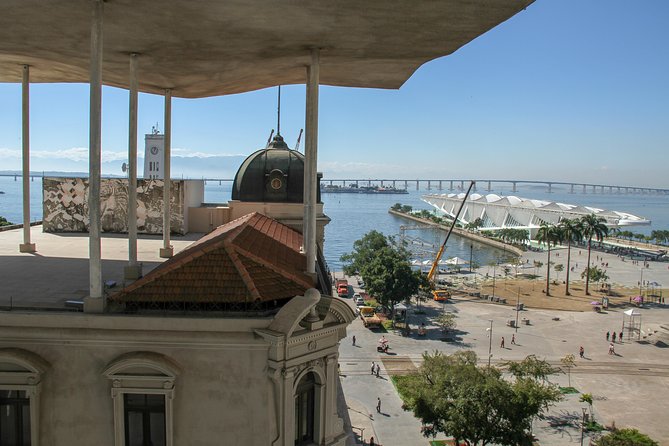
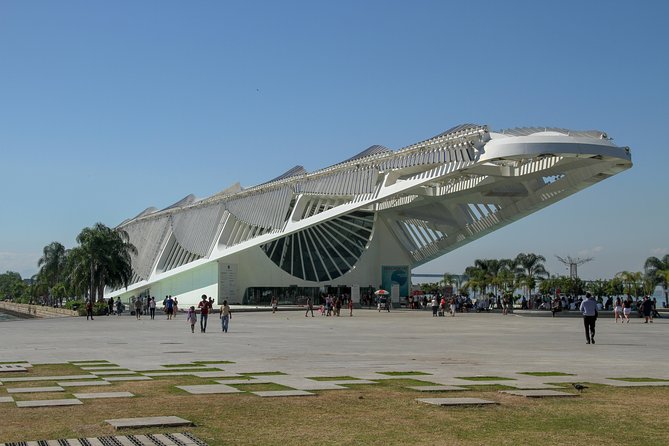
At Praça Mauá, the Museu de Arte do Rio combines historic and modern buildings and looks at the city’s art, social changes, and past. The nearby Museu do Amanhã takes a forward-looking approach to science, sustainability, and innovation in a bold waterfront building by Santiago Calatrava.
The Museu de Arte Contemporânea de Niterói requires a trip across Guanabara Bay, but its saucer-shaped Oscar Niemeyer design and views make it worthwhile for architecture fans. It is not a natural add-on to every central Rio route, so choose it instead of several other stops.
Museum admission is extra, and an eight-hour day does not allow long visits to all of them. Pick one or two.
Football, Carnival, and Rio’s public identity
Maracanã is essential for football fans. The stadium has hosted two FIFA World Cup finals and represents the force of football in Brazilian life. You can include it as an exterior stop or ask about admission if you want a fuller visit. The ticket is not included.
The Sambadrome is the city’s purpose-built Carnival parade venue, designed by Oscar Niemeyer. Outside Carnival season, it may be quiet, but the space still explains how samba competitions and parade culture are organized.
A football or Carnival theme can make the private format especially useful. Instead of squeezing both into a general city tour, you can ask the guide to explain what each place means and reduce time spent on sights that do not interest you.
Food and local suggestions are worth planning
The tour can focus on traditional food, and this is one area where a personal guide may add real value. One outing included a family-style local meal selected with the guide’s help, with abundant dishes and a bill that felt modest by United States standards. The group even had enough food left to send some home with the guide.
Food is not included, so set aside money and time for it. Tell the guide what you eat, what you avoid, and how much time you want at the table. A meal can be a highlight, but it will reduce the number of formal sights you can visit.
A farmers market was also used as a special addition on one private day, giving the group a chance to see unfamiliar fruit and vegetables and meet local people. If food matters more to you than checking off another monument, say so during the planning call.
Guides, languages, and the private vehicle
The guide is the heart of this experience. Victoria has led tours in Portuguese, English, German, and Spanish, while Niels was praised for fluent German. Ederson, Vicente, Gabo, Angelie, Thomas Vincent, and others have been singled out for friendly service, route changes, historical context, and help with lines.
The quality of the day can vary by guide, so request your preferred language clearly. One Spanish-language booking received a guide who spoke a weaker form of Spanish, while other language-specific experiences went very well. It is reasonable to confirm the language before the pickup date.
The driver matters too. A private vehicle lets you link far-apart areas and keep luggage with you in one reported airport-transfer arrangement. It also helps if someone in your group has limited mobility, since one guide adjusted the day so mobility concerns did not become a problem.
Pickup and drop-off at your Rio hotel are included. The stated start time is 8:00 am, though one booking suffered from a last-minute change and a delayed arrival. Confirm the time the day before and keep the operator’s message available.
Who should book this Rio tour
I would choose this experience if you have one full day in Rio, want to see the main sights efficiently, or have a detailed personal wish list. It suits couples, families, small groups, cruise visitors, and anyone who prefers a private vehicle to a large coach.
It is also a good match if you want to combine major landmarks with something specific, such as food, football, museums, beaches, or local neighborhoods. The guide can give you context while the driver handles the long connections.
I would not book it expecting a slow museum day, a full beach day, or a relaxed visit to all 30 places. Admission fees can add up, and the price makes the most sense when shared by two or three people.
The cancellation policy is forgiving if your plans change: cancel at least 24 hours before the start time for a full refund. Changes or cancellations inside that window are not refunded.
Should you book the Best of Rio private tour?
Book it if you value control, personal attention, and a strong first look at a huge city. Send a ranked wish list, reserve the big-ticket sights early, and ask for a route that avoids needless backtracking.
For the best balance, choose Christ the Redeemer, Sugarloaf, one beach area, Santa Teresa or the historic center, and either Tijuca Forest or a food stop. That gives you Rio’s views, culture, nature, and daily life without turning the day into a frantic race.
At $480, it is a premium day, but the private guide and driver can make it worthwhile for a small group with limited time. If you prefer slow travel or already know Rio well, a more focused half-day plan may serve you better.
FAQ
How long is the private Rio tour?
The tour lasts approximately eight hours.
What time does the tour start?
The stated start time is 8:00 am.
Is hotel pickup and drop-off included?
Yes. Pickup and drop-off at your Rio de Janeiro hotel are included.
How many people can join the tour?
The price is listed for a private group of up to three people. The included information also refers to private tours for up to 14 people, so confirm the exact group and vehicle limit when booking.
Are attraction tickets included?
No. Entrance tickets are paid separately. This applies to attractions such as Sugarloaf Mountain, Christ the Redeemer, the Botanical Garden, Maracanã, and the listed museums with admission charges.
Is food included?
No. Food and drinks are not included.
Can I choose the itinerary?
Yes. Before the tour, the guide contacts you to discuss an itinerary based on your interests, including food, sport, history, culture, major sights, or less familiar areas.
Is this a private activity?
Yes. Only your group participates in the activity.
What is the cancellation policy?
You can cancel at least 24 hours before the start time for a full refund. Cancellations or changes made less than 24 hours before the start time are not refunded.
Just added around Rio de Janeiro
- Rio de Janeiro: Zip Lining and Canopy Tree Tour★ 3.3 · 6 reviews
- Vidigal Favela Tour★ 4.4 · 26 reviews
- Hang gliding flight in Rio de Janeiro★ 5.0 · 6 reviews
- Unforgettable Boat Party★ 5.0 · 3 reviews
- Rio de Janeiro: Attend a Vasco da Gama game with local guide★ 4.8 · 9 reviews
- Rio Highlights: Christ, Sugarloaf, and More in a Private Tour★ 5.0 · 36 reviews
- Tijuca Forest Hike – Waterfalls & Caves, Nature & Wild Life!★ 5.0 · 51 reviews
- Tijuca Forest w/ Chinese View,cascatinha Taunay,horto waterfall and parque laje★ 4.5 · 29 reviews
Guided, compared.


Jeep Adventure: Guided Tour through Tijuca Rain Forest
Read our review →



Favela Rocinha Tour with Local Guide & Secret Spots
Read our review →